Brains aren't filing cabinets, but most knowledge systems are.
A cognitive architecture for AI systems.
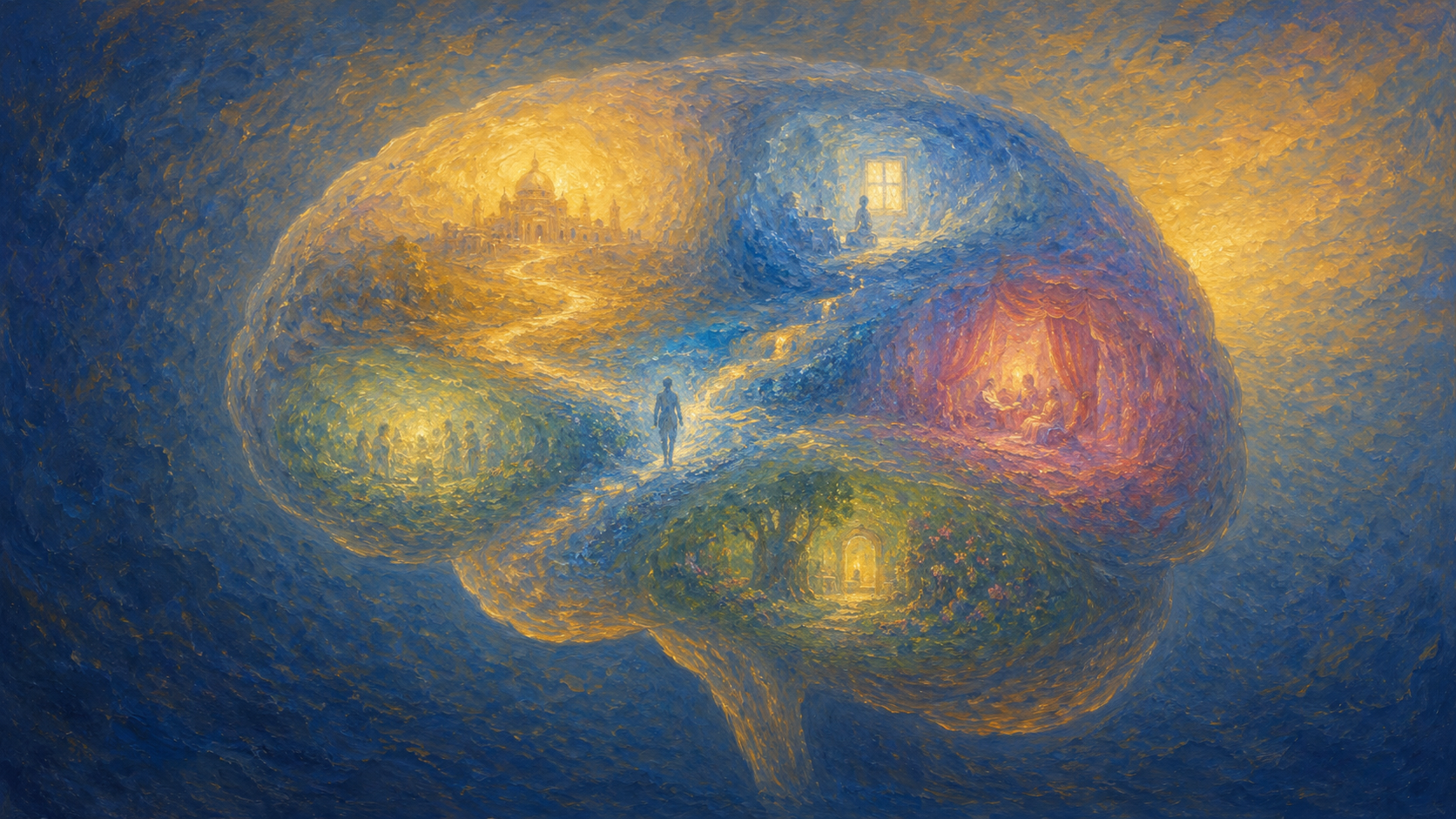
A growing number of people are building their own personal AI systems. Not chatbots. Operating layers. Skills, pipelines, memory, specialist agents that compound over time. The shift from using AI to running it.
I've been building one for the past year. It works. After months of skills, pipelines, and synthesis layers, it's a strong system for executing things. If I want to ship a piece of work, the system can probably do it.
What was bothering me wasn't the execution. It was the structure underneath.
The system was project-first. Everything was a project. Projects got plans, plans got pipelines, pipelines produced output. That works beautifully for shipping. It doesn't work for everything else.
Most of what I think about isn't a project yet. A thought I want to remember. A person I met. A piece of reading. A recurring concern that hasn't found a name. The project frame forces me to decide what each of these is for before the system can hold them. That's the wrong order.
What I wanted was a substrate where the funnel is the same regardless of what flows through it. Capture, consolidate, retrieve, synthesize, decide. The same loop, whether the input is a project or a half-formed thought.
And two more things on top of that. The system should prioritize naturally. Things I touch often, things that keep coming back, things connected to active work, those should rise on their own. Things I haven't engaged with in months should fade. Not by my command. By use.
The agent shouldn't load the whole vault every session either. It should pull what's relevant. Semantic retrieval, not bulk context. Most of what's in the vault should stay quiet most of the time.
So I started designing it. A knowledge vault. Personal. Persistent. Mine.
The first three drafts were the standard pattern. Folders by life area. Career, health, projects, writing. PARA-ish. The thing every "second brain" guide tells you to build.
It felt wrong. I couldn't say why for a while.
Then I started looking at how brains actually work.
Brains aren't filing cabinets
Brains are not organized by topic. There's no "career region" of your cortex. No folder for cooking. The visual cortex doesn't care if you're looking at a bike or a person. It processes vision either way.
Brains are organized by function. What kind of cognitive work is happening here. Memory consolidation, executive decision-making, sensory processing, motor coordination. The structure is about the operation, not the content.
Every PKM system I've ever seen does the opposite. They organize by content, not by function. Career goes here. Health goes there. Projects in this folder. The structure mirrors your life topics.
This is the project-first instinct showing up in a different costume. Whether you call it PARA, Zettelkasten, or "my Notion setup," the underlying assumption is the same: you decide upfront what something is about, then file it accordingly. That works until you have ten content areas, then twenty, and the structure becomes a filing problem rather than a thinking tool. You spend more time deciding where things go than using what you have.
I scrapped the topic-first design and rebuilt around brain anatomy.
The structure
Six top-level zones, each handling a specific cognitive function. Four borrow names directly from brain anatomy.
- Brainstem holds the rules. Voice, conventions, schema, privacy, salience policy. Operational, always-on, autonomic. The agent reads it on every operation.
- Cortex holds the content. Self, areas, projects, writing, knowledge. The conscious, deliberate layer. What I know and what I'm doing.
- Hippocampus handles time. Inbox, daily notes, weekly through annual consolidations, AI-generated synthesis. Memory consolidation as a folder structure.
- Cerebellum is the practiced operations. Skills, pipelines, specialist agents with their own diaries. The motor memory of the system.
- Sources is immutable raw input. Articles, books, transcripts. The originals, never edited.
- Archive is demoted content. Searchable, deprioritized, never deleted. Old projects, resolved deliberations, notes that have aged out of active life.
The shift is subtle but it changes everything downstream.
What it changes
When I capture a thought, I don't have to decide if it belongs to "career" or "design" or any other label. It goes into the inbox in the hippocampus, and gets routed later. The function (capture) is separated from the content (whatever the thought is about). Capture friction drops to zero.
The same funnel works for everything. A new project, a half-formed idea, a quote from a book, a person worth remembering. The system doesn't need to know what something is for before it can hold it. It just captures, lets the thing sit in the hippocampus, and waits for engagement to tell it what to do next.
When I write, the agent loads voice from brainstem, working context from cortex, recent state from hippocampus, and runs the article-drafting pipeline from cerebellum. Each layer does its job. None of them have to know what I'm writing about. The agent pulls slices, not the whole vault. The rest stays quiet.
When something ages, it doesn't get deleted. Salience drops. Eventually it moves to archive, mirroring its original path. Nothing is forgotten. The system grows from everything I put in, even the things I no longer actively use.
Specialist agents get their own diaries. The design critic agent has a record of every piece of work it's reviewed. The writing editor knows my voice patterns from accumulated sessions. They get better with use because they accumulate, not because they're retrained.
The cerebellum/cortex split mirrors the actual neuroscience. Cortex deliberates. Cerebellum executes practiced routines. In the vault, this means: cortex holds knowledge and decisions, cerebellum holds the operations that act on them. When you separate these, you can change one without breaking the other.
Three mechanics worth borrowing
Beyond the metaphor, three real principles from how brains work:
Salience over hierarchy. Brains weight memories by importance, not by where they're filed. Every note in my vault has a salience tier, set partly by template defaults and partly by my engagement signals.
Notes I reference, link to, and reopen drift upward in priority. Notes that gather dust drift down. Prioritization emerges from use, not from upfront decisions about importance.
Consolidation over storage. Sleep doesn't add memory. It compresses. Daily experience gets distilled into long-term knowledge.
The vault works the same way. Daily notes consolidate into weekly summaries, weekly into monthly, monthly into quarterly. The originals stay, but the agent reads the summaries. A vault of ten thousand notes operates the same as a vault of a hundred.
Decay, not deletion. Brains don't delete. They make memories harder to access. The vault has no delete operation.
Notes that lose engagement get demoted, eventually archived, never removed. Search still finds them, they just don't surface unless I ask. Nothing important is ever unrecoverable, but most things don't have to be in my face every day.
What surprised me
The structure I'd been resisting was already encoded in how my brain works. I was trying to design a system from scratch when there was an evolved reference architecture sitting between my ears.
Most "second brain" advice gets the metaphor backwards. People build systems that look like libraries: cataloged, categorized, retrievable. Brains aren't libraries. They're noisy, associative, decay-prone, salience-weighted, and constantly consolidating. The library model gives you a tidy archive. The brain model gives you something that actually grows.
The difference shows up most when the system gets large. A library at scale becomes a Dewey decimal problem. A brain at scale becomes more useful, because the consolidation and salience mechanics handle the volume.
You don't browse, you query. You don't file, you capture. The structure carries the weight you'd otherwise have to carry yourself.
What's next
The execution system continues as the toolbox. The brain vault is the substrate underneath. They run side by side, decoupled. One operates on its own surfaces. The other operates on mine.
Six months from now I'll know whether the design holds. The honest test isn't whether the structure looks elegant. It's whether I'm still using it without forcing myself to. Most personal knowledge systems collapse early. The ones that survive do it because the friction is low and the compounding is real.
If this one survives, I'll write about what actually worked. If it doesn't, I'll write about why. Either way the design taught me something I didn't expect: the next generation of personal AI systems probably won't look like apps or databases or chat interfaces. They'll look like cognition. Because that's the only architecture that scales with how we actually think.
Built on Obsidian, Claude, and a lot of rewrites. The thinking is still in progress.